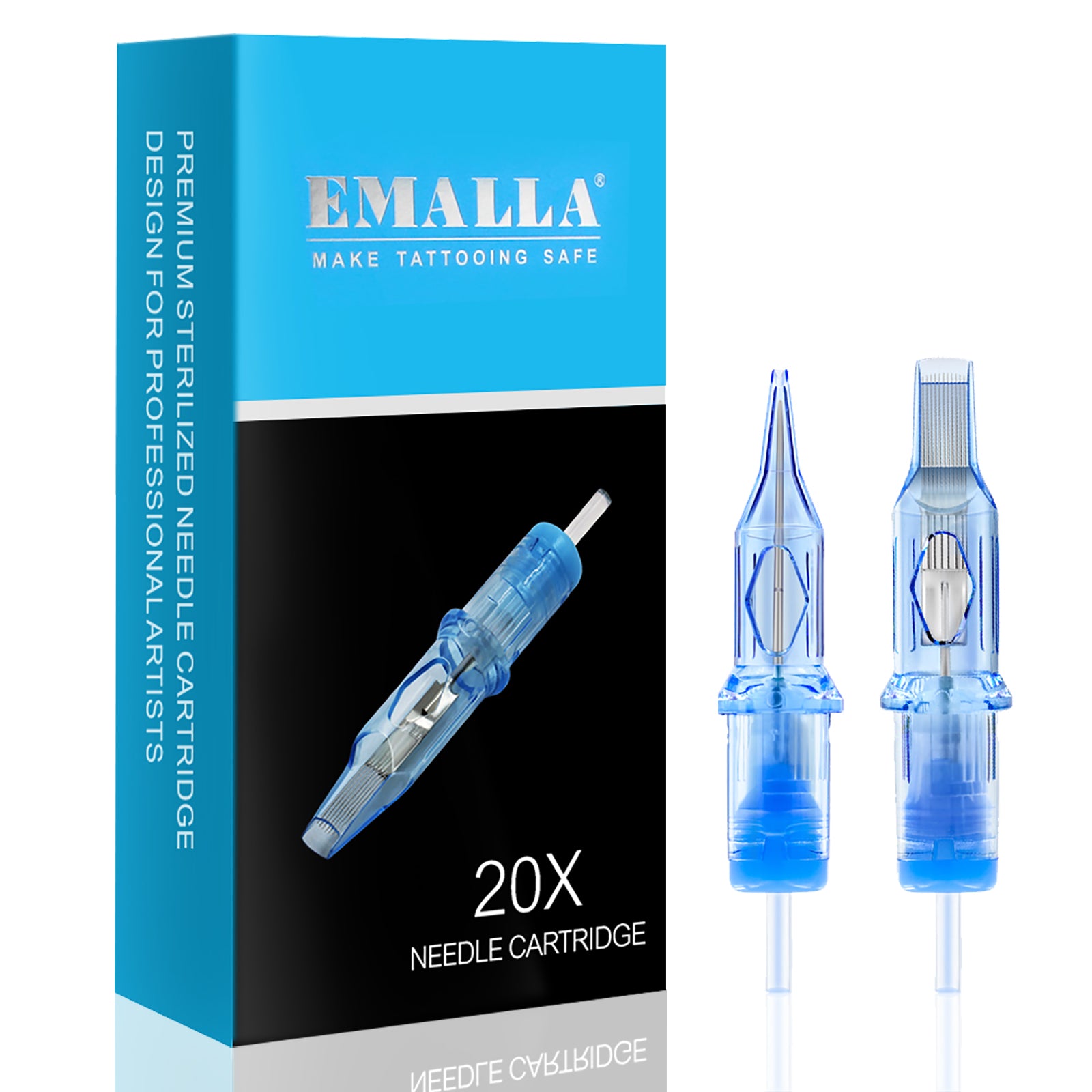
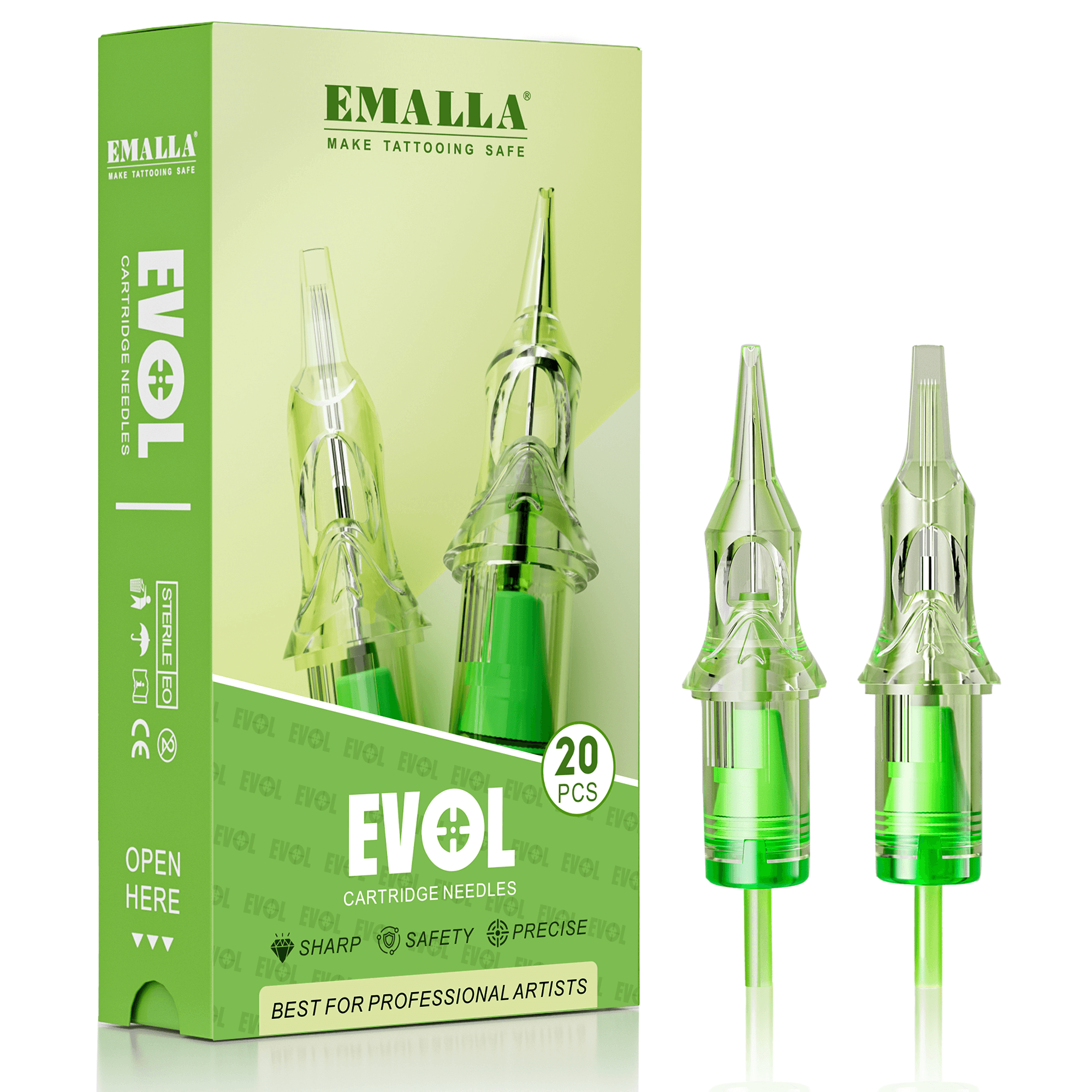

Choosing the right tattoo needle is not as simple as picking a 3RL for lines or a 15M for shading.
Understanding Tattoo Needle Configurations starts with looking beyond the number of needles. Diameter, needle count, grouping, and taper all influence how a cartridge delivers ink, how much coverage it provides, and how it responds to your technique.
For tattoo artists, the real question is not “Which tattoo needle is best?”
It is:
“Which needle gives me the right balance of control, ink flow, and coverage for this particular tattoo?”
This EMALLA Tattoo Needle Guide breaks down tattoo needle sizes and configurations in practical terms, helping you understand what the numbers and letters on a cartridge actually mean—and build a setup around your technique rather than guesswork.
How to Read a Tattoo Needle Code
Most tattoo cartridge needles use a code that tells you several important details about the needle inside. While the exact format can vary between brands, a typical code may look something like 0803RLL.
The code can usually be broken down into four key parts:
- 08 — Needle diameter or gauge: 0.25mm
- 03 — Needle count: 3 needles
- RL — Configuration: Round Liner
- L — Taper: Long
Learning to read these markings helps you understand what a cartridge is designed to do before you even open the box. When comparing tattoo cartridge needle sizes, look at the diameter, needle count, configuration, and taper together rather than relying on just one number.

Tattoo Needle Diameter: How Does Size Affect Your Work?
When reading a tattoo needle code, there are four key details to look at:
- Diameter — how thick each individual needle is
- Needle count — how many pins are in the grouping
- Configuration — how those pins are arranged
- Taper — how long the needle tip is
In this section, we'll focus on diameter. Also called gauge, it refers to the thickness of each individual needle. Common tattoo needle diameters include 0.18mm, 0.20mm, 0.25mm, 0.30mm, 0.35mm, and 0.40mm.
Diameter affects ink delivery. In general, smaller diameters provide finer, more controlled ink flow, while larger diameters allow more ink to move through the grouping. This makes diameter an important factor when choosing needles for fine detail, lining, shading, or color work.

| Gauge | Diameter | General Use |
|---|---|---|
| 04 | 0.18mm | Fine, controlled ink flow |
| 06 | 0.20mm | Fine line and detail work |
| 08 | 0.25mm | Detailed work with controlled flow |
| 10 | 0.30mm | Balanced flow for versatile work |
| 12 | 0.35mm | Bold lines, shading and packing |
| 14 | 0.40mm | Higher-volume ink delivery |
Keep in mind: there is no single “best” tattoo needle diameter. The right size depends on your technique, machine setup, ink, and the result you want to achieve.
Needle Count: Does More Needles Mean a Bigger Tattoo Needle?
Needle count refers to the number of individual needles in a grouping. For example, 3RL contains three needle points, while 9RL contains nine.
Within the same configuration and diameter, a higher needle count generally creates a wider working area and deposits pigment across a larger surface. This is why smaller groupings are often used for detail, while larger groupings are useful when more coverage is needed.

However, needle count should not be viewed on its own. A 7RL and a 7RS have the same number of needles but are designed for different purposes because their configurations are different.
Think of it this way: diameter tells you how thick each needle is, while needle count tells you how many needle points are working together.
The 4 Main Tattoo Needle Configurations
Once you understand diameter and needle count, the next step is choosing the right tattoo needle configuration. The arrangement of the needle points determines how the cartridge interacts with the skin and how pigment is distributed.

| Configuration | Best For | Choose It When You Need | Common Starting Sizes |
|---|---|---|---|
|
Round Liner (RL) |
Lines & detail | Clean, defined lines, fine line, lettering and precise details | 3RL / 5RL / 7RL |
| Round Shader (RS) | Small-area shading | Softer shading, small fills and controlled color work | 5RS / 7RS / 9RS |
|
Magnum (MG / M1) |
Shading & packing | Faster coverage, color packing, black & grey and solid saturation | 7MG / 9MG / 11MG |
| Curved Magnum (CM / RM) | Blending & soft shading | Smooth transitions, realism, portraits and softer edges | 9CM / 11CM / 13CM |
1. Round Liner (RL)
Best for: lining, fine line, lettering, detail and dotwork.
With needles grouped tightly in a circle, Round Liner cartridges create a concentrated ink deposit for defined lines. Smaller groupings such as 3RL and 5RL are commonly used for finer work, while larger groupings provide more substantial line weight.
Choose RL when line precision is the priority
2. Round Shader (RS)
Best for: soft shading, small fills and controlled color work.
Round Shader needles use a more open grouping than RL, spreading the needle points across a wider area. This makes them useful when you want softer pigment application without the broader coverage of a Magnum.
Choose RS for smaller shading areas and controlled transitions.
3. Magnum (MG / M1)
Best for: large-area shading, color packing, black and grey, and solid saturation.
Magnum cartridges use multiple rows of needles to cover more skin with each pass. Compared with a liner or shader, they are designed for efficient coverage and higher-volume pigment application.
Choose MG when coverage and saturation matter more than a narrow point of contact
4. Curved Magnum (CM / RM)
Best for: smooth shading, blending, gradients and realism.
The curved edge of a Curved Magnum gives the grouping a softer contact profile, making it particularly useful for smooth transitions and shading across curved areas of the body.
Choose CM when you want softer edges and controlled blending
Quick rule: Use RL for lines, RS for smaller shading, MG for coverage and packing, and CM for softer shading and blending. Your final choice should then be refined by needle diameter, needle count and taper.
What About Flat and Textured Needles?
Flat (F) needles have a straight-line grouping for specialized line work, while textured needles feature surface variations that can hold more ink for color packing. Both are more technique-specific options.
Tattoo Needle Taper: Why Does It Matter?
Tattoo needle taper refers to the length of the needle tip before it reaches its full diameter. Common taper categories include Medium, Long and Extra Long, although naming and specifications can vary between brands.
The taper influences how quickly ink is delivered and how gradually the needle reaches its full diameter. In general, a longer taper provides a more gradual needle profile and more controlled ink delivery, while a shorter taper tends to deliver ink more readily.

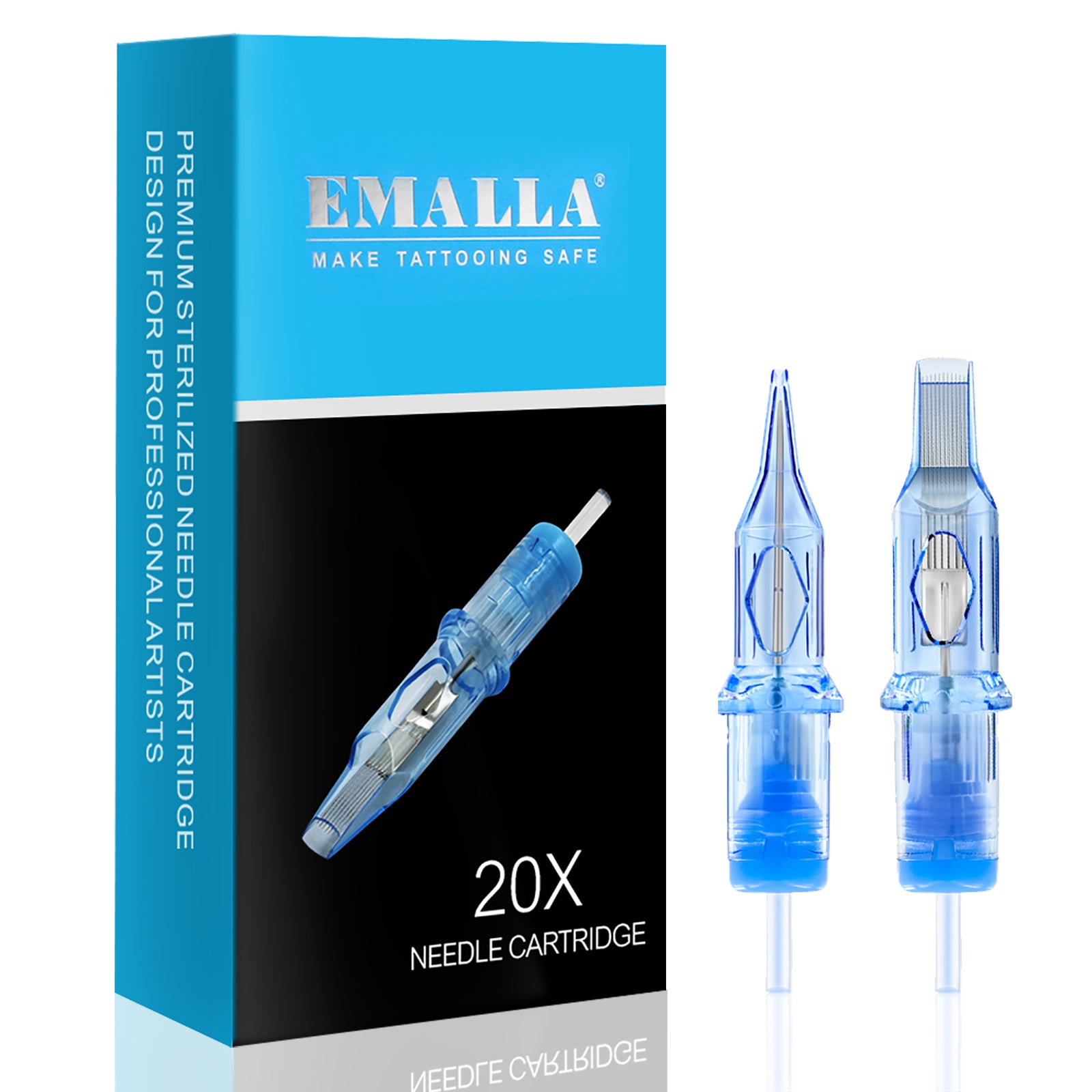
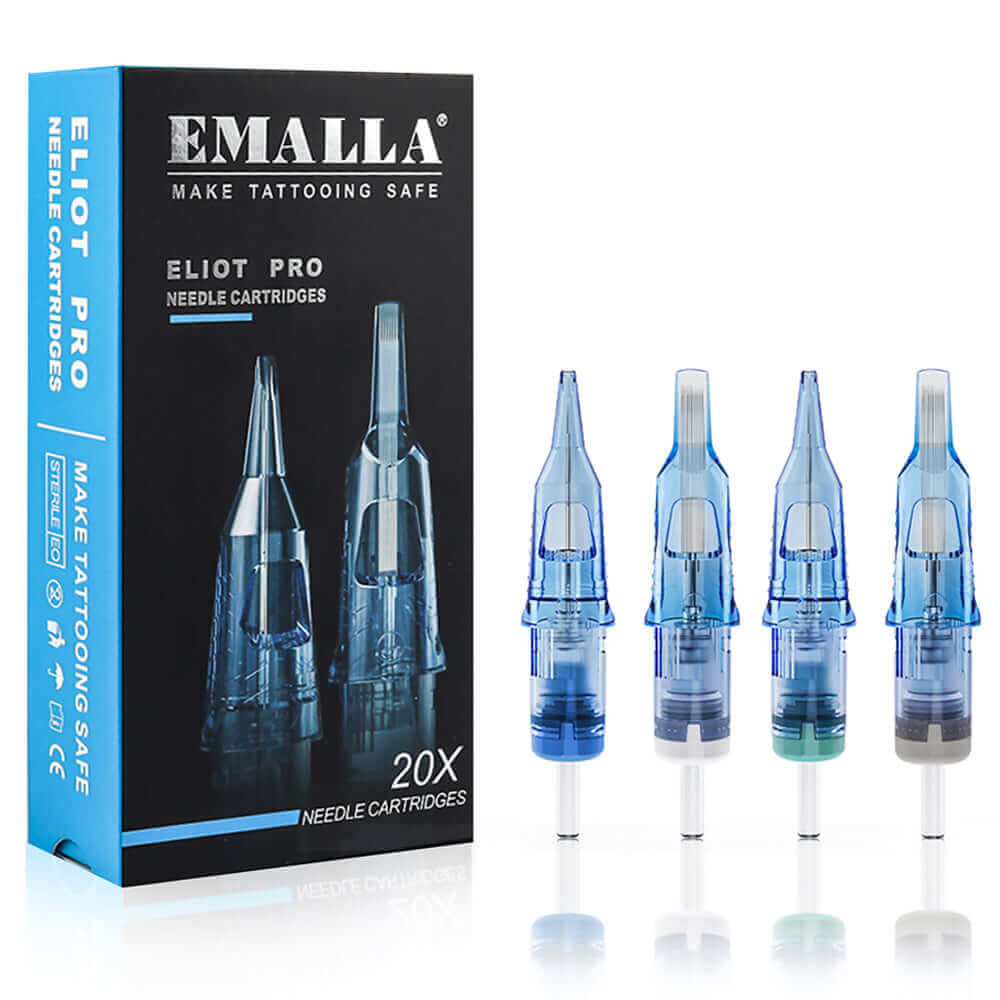
For example, EMALLA Eliot and Eliot Pro cartridges offer different taper options depending on the configuration. Their taper specifications include 3.5mm Medium, 5.5mm Long, and 7mm Extra Long on applicable configurations.
Rather than choosing a taper based on length alone, consider how it works with your diameter, configuration, hand speed and tattooing technique.
How to Choose Tattoo Needles for Different Tattoo Styles
There is no universal “best tattoo needle.” The right choice depends on what you are trying to put into the skin and how you want the finished tattoo to look.
| Tattoo Style / Task | Configurations to Consider | Common Starting Point |
|---|---|---|
| Fine Line & Detail | RL | 3RL / 5RL, smaller diameters |
| Traditional / Bold Lines | RL / RS | 7RL / 9RL / larger groupings |
| Small Shading Areas | RS / smaller CM | 5RS / 7RS / 9RS |
| Color Packing | MG / CM | 7MG / 9MG / 11MG |
| Black & Grey / Realism | CM / MG | 9CM / 11CM / 13CM |
| Large-Area Shading | MG / CM | 9MG / 11MG / 13MG+ |
These are starting points rather than fixed rules. Two artists working in the same style may prefer different combinations of diameter, count and taper based on their machine settings and hand speed.
How Many Tattoo Needle Sizes Do You Actually Need?
You do not need every available tattoo needle size to cover your everyday work. A more practical approach is to build a small selection around the techniques you use most often.
For many artists, a starting setup might include:
- RL: 3RL, 5RL and 7RL for different line weights and detail levels
- RS: 5RS, 7RS or 9RS for smaller shading and fills
- MG: 7MG, 9MG or 11MG for coverage and color packing
- CM: 9CM, 11CM or 13CM for blending and soft shading
From there, you can adjust the diameter and taper based on your preferred technique. The goal is not to collect the most configurations—it is to have the sizes you can use confidently and consistently.
Why Needle Stability Matters
Size and configuration are only part of the equation. The stability of the cartridge also affects how consistently the needle grouping performs during a tattoo session.
A well-designed cartridge should keep the needle grouping stable while maintaining consistent ink flow. This becomes especially important when working with fine lines, repeated passes, larger Magnum groupings, or techniques that require controlled transitions.
When comparing tattoo cartridges, look beyond the numbers on the box. Features such as the needle grouping, cartridge construction, membrane system and overall stability can all influence the experience of using the cartridge.
For artists comparing different cartridge systems, see our EMALLA Tattoo Cartridge Needle Comparison for a closer look at how different EMALLA series are designed for different needs.
5 Common Tattoo Needle Selection Mistakes
- Choosing by needle count alone: A 7RL and 7RS both have seven needles, but their different configurations produce different results.
- Ignoring diameter: The same configuration and count can perform differently at different diameters. Always check the gauge.
- Choosing taper without considering technique: Taper affects ink delivery and working response, so choose it based on your technique and hand speed.
- Buying too many sizes: Start with the configurations and sizes you use most, then expand your setup as needed.
A Simple Workflow for Choosing the Right Tattoo Needle
If you are standing in front of a selection of cartridges and are not sure where to start, use this simple four-step process:

Find the Right EMALLA Tattoo Cartridge for Your Work →
Final Takeaway
Choosing the right tattoo needle does not have to mean memorizing every configuration on the market. Once you understand how tattoo needle size, diameter, needle count, configuration and taper work together, you can narrow down your options quickly.
Start with the result you want to achieve, choose the appropriate configuration, and then fine-tune the diameter, count and taper to suit your technique. Over time, your own experience will help you build a reliable selection of cartridges for the work you do most often.